
Europe overlooks regions it cannot afford to ignore. India once slipped out of Europe’s strategic field of vision—until Europe understood the cost. The Western Balkans now risk becoming the next blind spot. While Europe shifts its economic focus toward Asia, other global actors expand their influence in the Western Balkans and reshape the political balance in a region that remains essential for Europe’s stability.
Europe faces pressure on every front—geopolitical, economic, and democratic. In this climate, the Balkans move back to the center of Europe’s vulnerabilities. Albania’s growing protests and the deep social exhaustion inside the country signal a development Europe cannot dismiss.
Albania stands outside the EU but inside Europe’s security architecture. Every shift in Tirana affects the continent. Albania belongs to NATO, holds EU candidate status, and sits at a geopolitical crossroads. Yet the country struggles with internal tensions that raise fundamental questions about the future of European democracy. Europe speaks of enlargement, but before new states join, it must understand the strength of their democratic foundations. Albania is not a peripheral case. Albania is a test.
Albania’s Foreign Policy Position Between the EU and the United States
Albania aligns closely with the United States. When Donald Trump introduced the “Peace Board” in Davos to address stability in the Middle East—including Gaza—the European Union declined the invitation. Albania accepted it. Prime Minister Edi Rama described the invitation as a “great honor,” according to Reuters. His reaction reveals Albania’s foreign‑policy instinct: the country stands firmly with Washington, even when the EU steps aside. As a NATO member, Albania navigates between European and American security interests and often chooses the American line.
The Geopolitical Context—Why the Balkans Matter
Many European media outlets treat the Balkans as a secondary topic, yet the region holds central strategic importance. The United States maintains a strong presence in Albania and expanded it further during the Trump administration. For the EU, the Balkans carry equal weight because security and democracy do not stop at the Union’s borders. Albania holds candidate status, and EU officials have mentioned 2027 as a possible accession horizon. Economically, Albania connects deeply with Europe: hundreds of thousands of Albanians work in Western Europe, and the country forms a growing consumer market for European goods. Political developments in Albania therefore shape Europe directly.
Berisha’s Speech in Strasbourg—A Symbolic Act of Protest
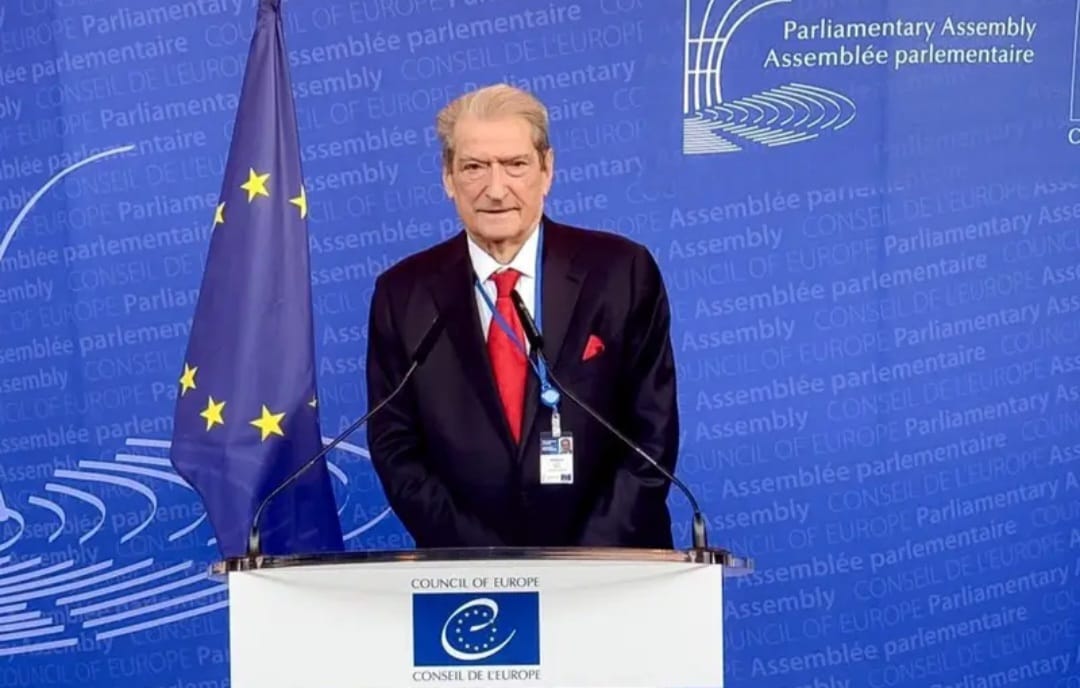
In this context, Sali Berisha chose Strasbourg to raise serious accusations against the Albanian government. He did not speak in a side room but before the EPP—the largest political group in the European Parliament. Whoever speaks there addresses Europe’s political core.
Berisha entered the room as Albania’s most experienced opposition leader, a historical figure who led the country into NATO. His appearance carried symbolic weight. He aimed to alert Europe to structural risks that extend far beyond Albania. After the meeting, he released a video in which he repeated his warnings about a “narco‑state” and a party‑controlled system. These points formed part of the message he brought to Strasbourg. Berisha’s Strasbourg Appearance (Official Instagram Reel.
The Press Conference—Berisha’s Own Account of His Strasbourg Message
Berisha held a press conference in which he explained what he had presented in Strasbourg. He said he had spoken before the EPP about the “narco‑state” and the “party‑state.” He also stated that he had described a case in which a person from the prime minister’s family circle allegedly forwarded Albanian internet data to enemies of NATO and to criminal clans. In addition, he spoke about the influence of Soros and criticized certain educational content.
These points form Berisha’s own account of what he presented in Strasbourg.
Berisha did not limit his visit to Strasbourg to his appearance before the EPP. He also met senior representatives of the Council of Europe, including Theodoros Roussopoulos, the outgoing President of the Parliamentary Assembly. These meetings show that Berisha placed his message deliberately at the institutional center of Europe.
Why Europe Remained Silent
Berisha’s appearance received almost no international attention. Major European media outlets ignored the speech, and even the EPP did not highlight it. This silence shows how little visibility the Western Balkans receive in Europe’s public sphere—even when political actors raise security‑relevant warnings at the highest level.
Europe must take seriously the fact that an opposition leader speaks in Strasbourg with such urgency. Berisha does not speak only for himself. He speaks for a large segment of Albanian society that has already mobilized in massive demonstrations. Their frustration forms a political reality Europe cannot overlook. Instability does not arise only from what Berisha describes as a ‘narco‑state’ or a ‘party‑state,’ but also from the growing discontent of citizens who feel excluded from their own political system. This dynamic affects Europe directly.
Europe reacts late. Europe reacts only when crises escalate. The Balkans form a geopolitical hinge, yet European media continue to treat the region as marginal.
Conclusion—Albania as Europe’s Test Case
Europe Cannot Afford Another Blind Spot
Europe does not need to endorse Berisha’s claims to recognize the significance of his warning. A political actor of his stature, speaking before the largest group in the European Parliament, reflects tensions that reach far beyond Albania’s borders. The Western Balkans remain a fragile hinge in Europe’s security architecture, and Albania’s internal pressures—social, political, and institutional—carry direct consequences for the continent. Europe has paid a high price for ignoring strategic regions in the past. It cannot afford to repeat that mistake in its own neighborhood.