The world extracts Sudan’s gold at bargain prices instead of helping the country build an economy on its own gold, land, and oil—and then sends back just enough humanitarian aid to keep people alive in a war that this very gold helps to finance
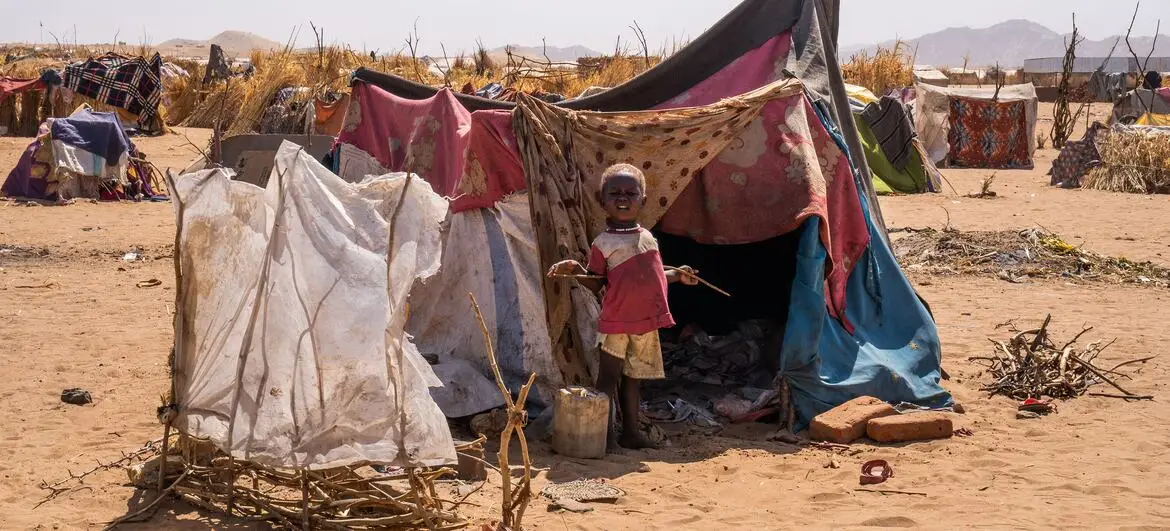
An estimated 150,000 people are dead in a country with enormous agricultural, gold, and oil potential. Around 20–25 million people are in acute food insecurity, almost half the population dependent on aid. Between 12 and 13 million internally displaced people, plus more than four million refugees—the largest displacement crisis in the world. More than two out of three hospitals in the hardest‑hit areas are fully or partially out of service.
As the war nears its fourth year, UNHCR and 123 partner organizations have launched a $1.6 billion appeal to support more than four million Sudanese refugees across seven neighboring countries.
Are there any more shocking numbers than these to justify finally turning a resource‑rich country into a truly prosperous one?
Are there any more shocking numbers than these to justify finally turning a resource‑rich country into a truly prosperous one? Are there any stronger reasons than this to enforce peace, if those in power really cared about peace? With 85 million hectares of arable land, access to the Nile, large herds of livestock, oil, and, above all, gold deposits, Sudan could be a regional breadbasket and energy hub. Anyone who finances bombs instead of wells in Sudan today is deliberately choosing against a country that could feed itself—and help feed its region.
That Sudanese lives seem to “count less” has to do with both sides of the equation: with a Sudanese power elite that has driven the country into this war and privatized its resources, and with the foreign policies of other states that help sustain this system through deals over gold, weapons, migration control, and strategic silence.
What Is Happening in Sudan—in Three Sentences
Since April 2023, Sudan’s army (SAF) has been at war with the Rapid Support Forces (RSF) militia—a conflict triggered by a power struggle at the top of the military and by disputes over whether and how the RSF should be integrated into the regular army. Both sides have committed grave abuses: massacres of civilians, the forced displacement of entire neighborhoods, looting, systematic sexual violence. In regions like Darfur, the violence often has an ethnic dimension that observers already describe as a possible precursor to genocide. This is not a “normal” civil war, but the largest displacement and one of the most severe hunger crises in the world—with a collapsing health and food system in which even a single child’s survival has become a lottery.
A Rich Land—Power, Business, and Natural Resources
The war in Sudan is also a war over business. Army chief Abdel Fattah al‑Burhan and RSF commander Mohamed Hamdan Dagalo (“Hemedti”) sit atop networks of companies, smuggling routes, and political connections that turn one of Africa’s most resource‑rich countries into a private business model. They sell gold, land, and labor abroad – and buy weapons, loyalty, and international protection in return.
Hemedti’s RSF trace their origins back to the Janjaweed militias that, acting on behalf of the regime, burned, raped, and depopulated villages in Darfur. Later, they were formalized, given access to gold mines and border trade, and turned into the regime’s private “security ”company”—with independent revenue, personnel, and foreign policy. This is the basis of Hemedti’s close ties to Gulf states, Libyan warlords, and Russian mercenary structures: the RSF supplied fighters for wars in Yemen and Libya, guarded borders against migrants, and controlled gold mines whose output flowed through neighboring countries toward the Gulf and beyond.
The regular army under Burhan is not a neutral state actor either but part of an economic power bloc. Sections of the security apparatus control ports, agricultural projects, real estate, and trade networks; many big deals involving land leases, livestock exports, or infrastructure projects run through companies linked to the military. Those who allocate land, sign lease contracts, or issue export licenses hold the real power—and they are almost always located in Khartoum or other military centers, not in the poor provinces.
Sudan is not poor because it has nothing. It has fertile farmland, large herds, oil and, above all, gold, for years it was considered the breadbasket of the region. After South Sudan’s secession, much oil revenue was lost, but gold and land became new sources of foreign currency—and fell even more firmly into the hands of armed elites. Poverty here is not caused by a lack of wealth but by the way wealth is organized to flow upward and outward. Revenues from raw materials end up in the pockets of the army, the RSF, and their business networks, while decades of war and corruption have destroyed factories, farms, and infrastructure.
The result is a stark paradox: a country rich in resources and potential becomes a stage on which generals, militias, and foreign partners strip out wealth. Ordinary people see almost none of it. Instead, they pay twice—first as cheap labor in mines and mercenary units, and then as targets of bombs, hunger, and disease when the very same revenues are plowed back into an endless war.
Who Keeps the War Going: Internal Elites and External Hands
The war in Sudan is made from within but prolonged from outside. At the top stand two armed power structures that are not fighting for democracy but for gold, land, influence, and international recognition. The regular army (SAF) under Burhan and the RSF under Hemedti each control their own companies, smuggling networks, and resource portfolios—from gold mines in Darfur to farmland along the Nile—and turn a rich country into a private profit machine. Revenues from gold exports, mercenary services, and land deals do not fund schools or hospitals; they finance weapons, militias, and patronage networks. The population pays in poverty, displacement, and hunger.
Around them is a belt of regional and global actors who may not have “started” the war, but who clearly help sustain it. Egypt mainly supports the SAF, trains officers, and sees Burhan’s army as a guarantor that conflict and refugee flows will not spill over its southern border or undermine its Nile water policy. The United Arab Emirates are widely seen as the RSF’s most important patron, through gold deals, logistics, political backing, and—according to numerous reports—weapons supplies, officially denied but repeatedly documented. Other states—Russia, Turkey, Iran, Saudi Arabia—line up behind either the SAF or the RSF, seeking access to ports, air bases, and lucrative projects on the Red Sea and further inland.
Western states are part of this picture too, often in more indirect ways. In the years before the war, militias like the RSF were upgraded with funding, equipment, and political recognition in the name of “border security” and migration control, because they were stopping people on their way to Europe. For years, European migration policies helped fund and legitimize Sudan’s militia state by supporting border control forces, including the RSF, while the United States and others only began sanctioning RSF- and army-linked gold and business networks—and accusing the RSF of genocide—once the war was already in full swing. Today, the US and EU invest diplomatic energy in ceasefire talks and “processes,” but at the same time remain heavily focused on their own security and migration agendas and shy away from real pressure on their regional partners. In practice, Sudan has become a geopolitical playground on which generals, regional autocrats, and global powers act out their rivalries—while almost all the dead are Sudanese, and the bill is paid by people who had no say in any of these decisions.
It’s Foreign Policy, Too
The war in Sudan is not only the result of a ruthless internal elite but also of foreign policies that buy Sudanese gold, pay militias as “border guards,” and keep supplying partners despite their role in the war. Acting this way is a choice against Sudanese lives and against the possibility that a resource-rich country might one day live off its own wealth instead of dying from it.
For years, European migration policies have channeled money, training, and equipment into Sudan’s security apparatus in the name of “better migration management” in a context where militias like the RSF patrolled key borders. At the same time, buyers of Sudanese raw materials demand low prices and smooth supply chains but rarely ask whether that “cheap” gold or livestock rests on war wages, land grabs, or massacres.
Instead of helping Sudan build an economy based on its own gold, land, and oil, the world extracts its resources and then sends back humanitarian aid to keep people alive. Poverty and hunger here are not the result of a lack of wealth, but of a system that exports wealth and imports aid.