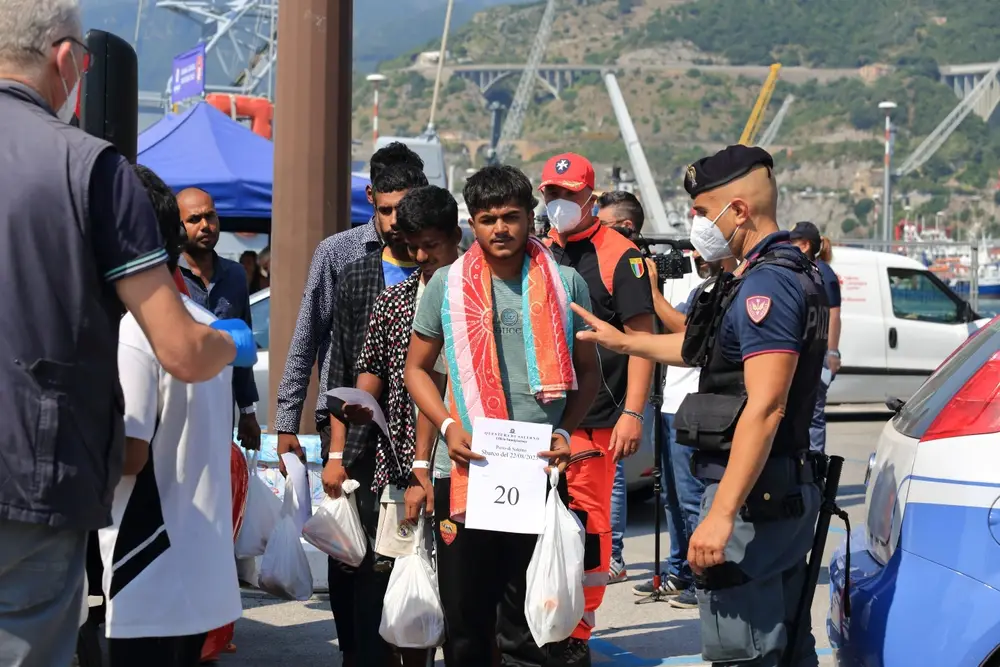
On 23 and 24 March 2026, the Court of Justice of the European Union (CJEU) held hearings on whether Italy’s controversial Italy‑Albania migration deal is compatible with EU law. It is the first time the EU’s top court directly examines if a member state may shift parts of its asylum and return system to a non‑EU country.
Europe does not treat all non‑EU countries the same. It actively recruits workers from Albania into the European labor market. At the same time, it explores whether people from other non‑EU countries can be offshored to Albania to keep them out of Europe. The Italy‑Albania deal rests on one basic fact: Albania is formally not an EU member, which makes it easier to outsource European responsibilities. This structural divide between “wanted” and “unwanted” non‑EU populations exposes the contradictions at the heart of the Meloni–Rama pact and the EU’s new migration architecture.
The Contradiction at the Heart of EU Review
Officials in Brussels and Luxembourg focus on legal questions. They ask whether Italy can lawfully transfer people it intercepts at sea to two Italy‑run facilities in the Albanian towns of Gjadër and Shëngjin, even though these centers sit outside EU territory. The core question is not whether this model is fair, rational, or workable, but whether it can be engineered so that it appears formally compatible with EU law on paper. Labor markets, integration, and real living conditions hardly play a role in this review. What matters is whether an offshore system on Albanian soil can be framed as a “clean” legal extension of Italy’s asylum and return machinery. That narrow, formal focus reveals a deeper structural inequality: Albania becomes both a labor reservoir and a potential holding zone, and different groups of non‑EU nationals are managed in radically different ways.
Two Non‑EU Countries – Completely Different Treatment
For Albanians, one of these two non‑EU groups, the EU – led by Germany – has opened legal pathways straight into European labor markets. Under the so‑called Western Balkans Regulation, nationals of Albania, Bosnia and Herzegovina, Kosovo, Montenegro, North Macedonia, and Serbia can obtain German work visas relatively easily if they secure a job offer. As of June 2024, Germany doubled its annual quota under this scheme from 25,000 to 50,000 approvals because its economy urgently needs additional workers. By the end of 2023, roughly 76,000 Western Balkans nationals were legally living and working in Germany under this single regulation – a 22 percent increase compared to 2022. Albanian workers are openly advertised as part of the solution for labor shortages in care, construction, hospitality, logistics, and agriculture. Education and training costs stay in the sending states, while tax revenue flows to the EU.
For many people from African non‑EU states, the picture looks very different. They are not meant to reach EU soil at all – even when they flee war, persecution, or extreme poverty. Instead of opening legal work channels, EU governments negotiate externalization deals. Under these arrangements, people are transferred to so‑called “safe third countries” such as Albania or to transit countries in Africa, far from EU labor markets and courtrooms. Formally, African nationals can also apply for German work visas – but only under much stricter skilled‑worker rules and without any special scheme comparable to the Western Balkans Regulation. The paradox is stark: Albania itself suffers from massive emigration and chronic labor shortages, yet it is supposed to become a holding zone for other non‑EU nationals – people who are denied access to the very labor markets that Albanians legally enter.
Both groups – Albanians and many Africans – come from non‑EU countries marked by high unemployment, fragile welfare systems, and intense economic pressure. Yet one group receives visas and work contracts inside the EU, while the other is pushed into outsourced detention and fast‑track rejection procedures, kept in limbo, or forced back across borders. In legal terms, this matches the idea of structural or indirect discrimination: facially “neutral” rules that consistently leave one group – here predominantly Black Africans – worse off than other non‑EU populations. Politically, this asymmetry is sold as “migration management.” In practice, it creates a regime of unequal treatment where origin and race help decide who counts as a worker and who is framed as a security threat.
The Meloni–Rama Model: A System Designed to Block Work
Whether you look at Albania or Senegal, Nigeria or Kosovo, research is clear. The main drivers of migration are income, stability, support for family members, and long‑term prospects. The popular claim that “most refugees are coming for benefits” does not stand up to the evidence, especially in countries where many migrants end up in precarious, low‑paid jobs rather than in generous welfare systems.
The Italy‑Albania deal targets this reality – but not to enable work, rather to interrupt it. The twin centers in Gjadër and Shëngjin were designed to process up to 3,000 people per month in accelerated procedures, quickly screening and then returning as many as possible, without giving access to the regular Albanian labor market, integration programs, or realistic prospects. Between late 2024 and mid‑2025, only 73 migrants were actually transferred to Albania; Italian courts then ordered all of them back to facilities on Italian soil because the legal construction could not withstand scrutiny. The centers have remained largely empty while costing significantly more than comparable facilities in Italy – an expensive theater of deterrence that addresses neither labour demand nor the root causes of displacement.
At the very moment Italy tries to intern people in Albania, tens of thousands of Albanians leave their country each year to work in EU states. Studies estimate that in some Western Balkans countries, several percent of the working‑age population now live and work in the EU, with serious consequences for domestic welfare systems and economic development. Albania effectively imports EU‑level prices through trade and currency ties but produces comparatively little value added at home, as its most mobile and qualified workers depart while “undesired” migrants are supposed to be parked on its territory. Average wages in Albania remain among the lowest in the region. Housing prices in Tirana rank among the highest in Europe relative to purchasing power, which makes it hard for many young Albanians to cover rent and basic living costs from a typical salary. A country that struggles to offer its own citizens a viable future becomes a stage for EU migration policy – and is asked to help block the futures of others.
A system that deliberately prevents people from working cannot “solve” migration; it only pushes it into legal and geographic gray zones. It ignores the main motivation of most migrants and produces new conflicts, costs, and insecurities instead of aligning economic reality with basic human rights.
What the CJEU Reviews – and What It Leaves Out
The current CJEU proceedings revolve around one central issue: can Italy legally externalize parts of its asylum and return system to Albania? The judges examine notions like “safe third country,” territorial jurisdiction, and the scope of EU asylum procedure rules, which usually require that claims be processed on member‑state territory. They must decide whether a scheme that places centers on Albanian soil but keeps them under formal Italian jurisdiction is compatible with EU secondary law and the EU Charter of Fundamental Rights.
The Court will not rule on whether this hierarchy between different non‑EU groups is fair, but its decision will define how far member states can legally go in outsourcing parts of their migration control.
Barely addressed in these legal debates are basic questions. Do the people concerned have any real access to labor markets, to a stable life, to integration – in the EU or in Albania? Does anyone take into account that Albania itself structurally depends on labor emigration and is hollowing out its economic base as workers depart? And above all: does this model deepen the unequal treatment between different non‑EU groups – between privileged Balkan workers and outsourced African asylum seekers – or does it reduce it?
If a system cannot work in the real world because it ignores work, integration, and economic logic, then a purely formal review risks becoming a legal simulation. What is being tested is less the system itself than its disguise. The real question seems to be whether an offshore detention regime can be dressed up so that it looks “compliant” on paper while producing inequality and hopelessness in practice.
What the EU Says It Wants – and What Member States Actually Do
The EU’s new Pact on Migration and Asylum is marketed by the Commission and member states as a “historic agreement” that will secure borders, speed up procedures, and strengthen solidarity. In reality, it centers border procedures, returns, and externalization. It also creates a stronger common framework for designating “safe third countries” – exactly the legal tool needed to underpin deals like the Italy‑Albania arrangement. Italy under Giorgia Meloni presents itself as a pioneer of tough deterrence even as it relies on legal labor migration and repeatedly faces resistance from its own courts over the Albanian centers. Germany and other core states, meanwhile, widely open the door for Western Balkans workers through permanent and expanded schemes, while avoiding a clear political rejection of outsourcing asylum processing to third countries. The official language is “European solutions”; the unofficial logic is: useful non‑EU people in, the rest out – or far away.
The Unanswered Question for Europe
In the end, one blunt question remains – a question the system poses to itself but has not yet answered honestly:
How can Europe systematically recruit workers from one non‑EU country while at the same time exploring whether people from other non‑EU countries can be offshored to that very place so they never reach Europe in the first place?
As long as Albanians are welcomed into the EU as workers while African refugees are slated for holding centers in the same country, talk of “values,” “equality,” and “solidarity” looks like a carefully drafted legal façade – and the EU’s hidden hierarchy becomes impossible to miss for anyone willing to look.