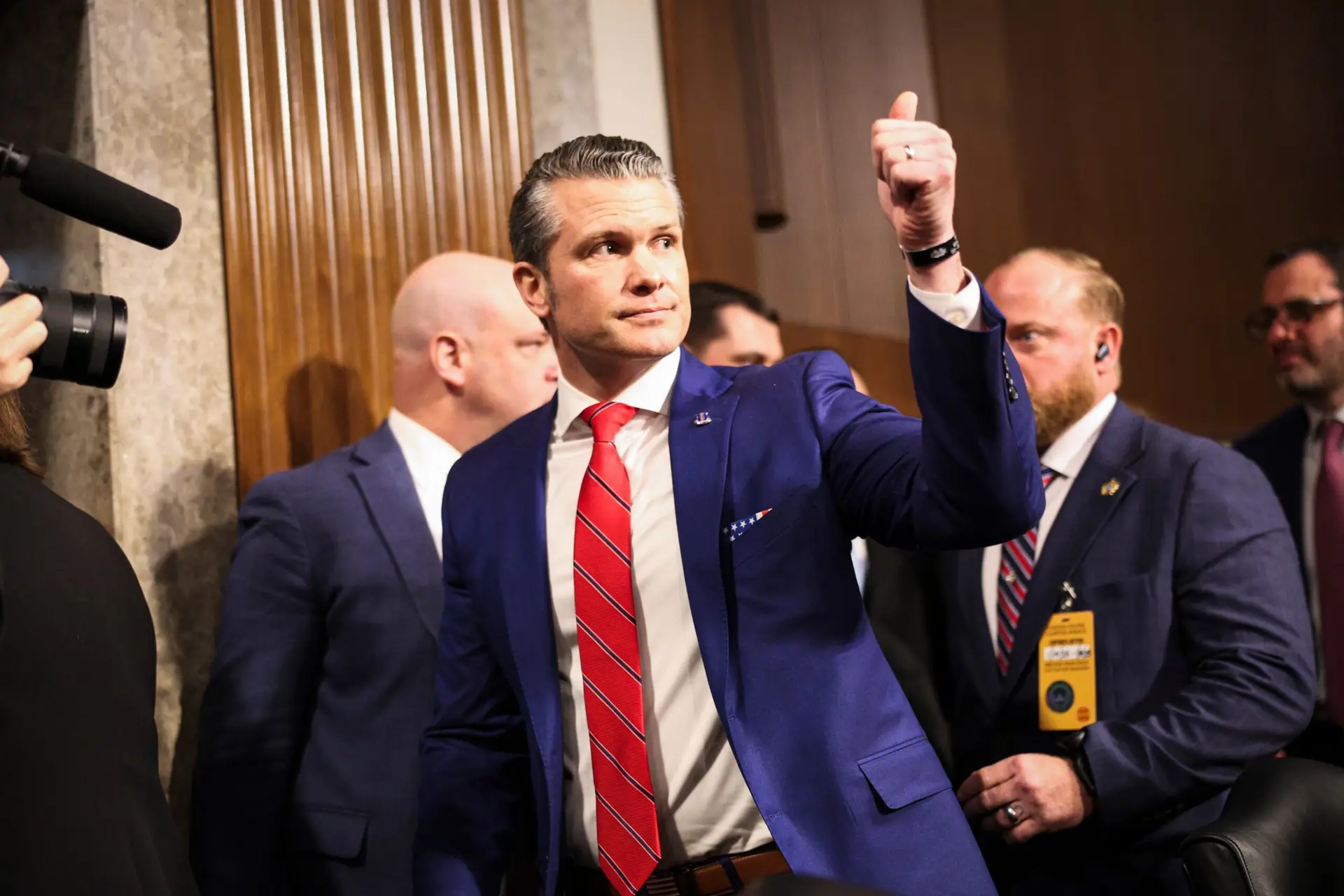
The Pentagon’s latest briefing did far more than provide an operational update. It revealed a strategic posture — one that blends military force with diplomatic signaling, and one that appears increasingly willing to accept regional spillover as part of its calculus. What emerged from Defense Secretary Pete Hegseth’s remarks was not simply a snapshot of the current battlefield, but a window into a broader doctrine shaping the United States’ approach to a rapidly widening conflict.
Across multiple international outlets, today’s live updates show a war that is no longer confined to a single front. It is expanding across borders, straining alliances, and pulling institutions into its orbit. The language used by US officials, the scale of military activity, and the reactions from regional actors all point to a conflict entering a more volatile and unpredictable phase.
“The US is willing to ‘negotiate with bombs.’” — A shift in the meaning of diplomacy
Hegseth’s statement that the United States is willing to “negotiate with bombs” is not merely rhetorical flourish. It reflects a strategic approach in which military action is framed as a form of communication—a way to shape the negotiating environment by demonstrating capability and resolve.
This formulation blurs the traditional boundary between diplomacy and force. Instead of viewing military action as a last resort, the phrase suggests that Washington sees kinetic operations as part of the diplomatic toolkit. It implies that the US believes negotiations can be influenced, accelerated, or constrained through the application of military pressure.
Such language also signals to adversaries that the US is prepared to escalate if necessary, and to allies that Washington expects alignment with this more assertive posture. It is a message designed to project strength, but it also raises questions about the long‑term implications of normalizing force as a bargaining instrument.
“Unpredictable” with “boots on the ground”—strategic ambiguity as leverage
Hegseth’s second major statement — that the US aims to be “unpredictable” with “boots on the ground” — adds another layer to the emerging doctrine. Unpredictability is often used as a deterrent, keeping adversaries uncertain about red lines and thresholds. But linking it to the possibility of ground forces elevates the stakes considerably.
This kind of ambiguity serves multiple purposes. It signals to Iran that Washington is not limiting itself to airpower, while simultaneously pressuring regional partners to prepare for scenarios they may not have anticipated. At the same time, it shapes public perception by framing unpredictability as a deliberate strategic choice rather than a reactive posture.
By invoking “boots on the ground,” Hegseth introduces the possibility — even if remote — of a deeper US military commitment. This creates a psychological environment in which adversaries must consider a wider range of potential US actions, and allies must reassess their own positions.
Pentagon claims more than 11,000 targets struck—a war fought at scale
The Pentagon’s assertion that the US has struck more than 11,000 targets highlights the intensity and breadth of the military campaign. Such a figure suggests a sustained operational tempo across multiple theaters, involving a wide range of assets and objectives.
This scale raises important analytical questions, including what categories of targets are included in this count, how many were military installations versus logistical hubs or infrastructure, and how many were dual‑use facilities. It also invites scrutiny over the criteria used to designate a site as a “target.”
Large‑scale operations often have cascading effects on supply chains, civilian life, regional stability, and diplomatic relations. The number itself becomes part of the messaging, signaling capability and resolve while also shaping perceptions of progress.
US allies criticized for “failing to support” operations in the Strait of Hormuz—A coalition under strain
Hegseth’s public criticism of US allies for not supporting operations in the Strait of Hormuz marks a notable moment. The strait is one of the world’s most critical maritime chokepoints, essential for global energy flows, and a lack of coordinated action there can carry significant geopolitical and economic consequences.
The criticism reveals underlying tensions within the Western coalition. The United States is pushing for more active involvement, while European partners remain cautious, balancing domestic pressures and regional concerns. At the same time, Gulf states are recalibrating their positions amid shifting security dynamics.
Even Trump echoed this frustration, criticizing European allies for “not doing enough.” These public statements highlight fractures that could complicate efforts to maintain a unified front as the conflict evolves.
Lebanon: 1,268 killed—and UN peacekeepers among the dead
The rising death toll in Lebanon—now at 1,268—underscores the conflict’s expanding humanitarian impact. The deaths of three Indonesian UN peacekeepers add an international dimension, as attacks on UN personnel carry significant diplomatic implications.
Lebanon has become a secondary battlefield, with spillover effects that risk drawing additional actors into the conflict. The presence of UN casualties signals that the conflict is affecting not only regional players but also international institutions tasked with maintaining stability.
This development raises concerns about escalation, civilian protection, and the ability of peacekeeping missions to operate safely in increasingly volatile environments.
Iran denies firing missiles at Türkiye—a reminder of regional volatility
The Iranian foreign minister’s denial of reports that Iran fired missiles at Türkiye highlights the fragility of regional dynamics. Even unverified claims can generate diplomatic tension in an environment where multiple actors are engaged in overlapping conflicts.
The plausibility of such a rumor reflects the complexity of the situation, where Israel is conducting operations in Lebanon, the United States is striking targets in Iran, the Houthis remain active in the Red Sea, and Gulf states are reassessing their security strategies.
In such a context, misinformation or misinterpretation can escalate quickly, underscoring the need for careful communication and verification.
Universities become a new frontline — and Iran threatens to target them
Reports that universities are emerging as a new frontline in the conflict represent a significant shift. Iran’s threat to target US‑ and Israeli‑affiliated universities introduces a dimension that extends beyond traditional military or political arenas.
Academic institutions function as centers of research, cultural exchange, and international collaboration. Targeting them would directly affect academic freedom, global mobility, and the safety of students and faculty.
This development reflects how the conflict is expanding into areas previously considered outside the scope of military engagement, raising concerns about broader societal consequences.
A war expanding across borders, alliances, and institutions
Taken together, today’s developments illustrate a conflict widening across multiple dimensions. Geographically, it spans Iran, Israel, Lebanon, the Red Sea, and the Strait of Hormuz, with even rumors involving Türkiye. Diplomatically, tensions are visible in US frustration with European allies, Gulf states adjusting their positions, and countries like Pakistan navigating complex regional pressures.
Institutionally, the conflict is now touching universities, UN peacekeepers, and civilian infrastructure. At the same time, its rhetorical framing — through phrases such as “negotiate with bombs,” “unpredictable,” and “boots on the ground” — signals a shift in how power and escalation are communicated.
These elements point to a conflict that is not static but evolving, with implications extending far beyond the immediate battlefield.
The doctrine emerging from today’s statements
The US posture appears to rest on three key pillars. First, it treats force as a form of negotiation, using military action to shape diplomatic outcomes. Second, it embraces unpredictability as a strategy, leveraging ambiguity to influence adversaries and manage alliances. Third, it uses scale as a form of legitimacy, presenting large numbers of strikes as evidence of progress and resolve.
Together, these pillars suggest a strategic approach focused less on rapid de‑escalation and more on maintaining pressure while shaping the broader environment.
The world is entering a new phase—and today’s statements made that clear
The Pentagon’s briefing was not just an operational update. It signaled how the conflict is likely to evolve — broader in scope, more complex in its alliances, more intertwined with institutions, and increasingly unpredictable in its trajectory.
The developments of the past hours indicate that the conflict is entering a phase where military, diplomatic, and societal dimensions are deeply interconnected. This is no longer a contained regional confrontation, but a shifting geopolitical landscape unfolding in real time.