


The Question Isn’t Whether Rama Steps Down—He Must. The Real Question: Can Albania Afford to Let Him Go Without Tearing Up the 2008 Electoral Pact First?
Under the guise of demanding snap elections, Albania's protest movement risks preserving the very 2008 Electoral Pact that Sali Berisha and Edi Rama engineered to systematically crush emerging parties and throttle independent political leadership.

Share your love
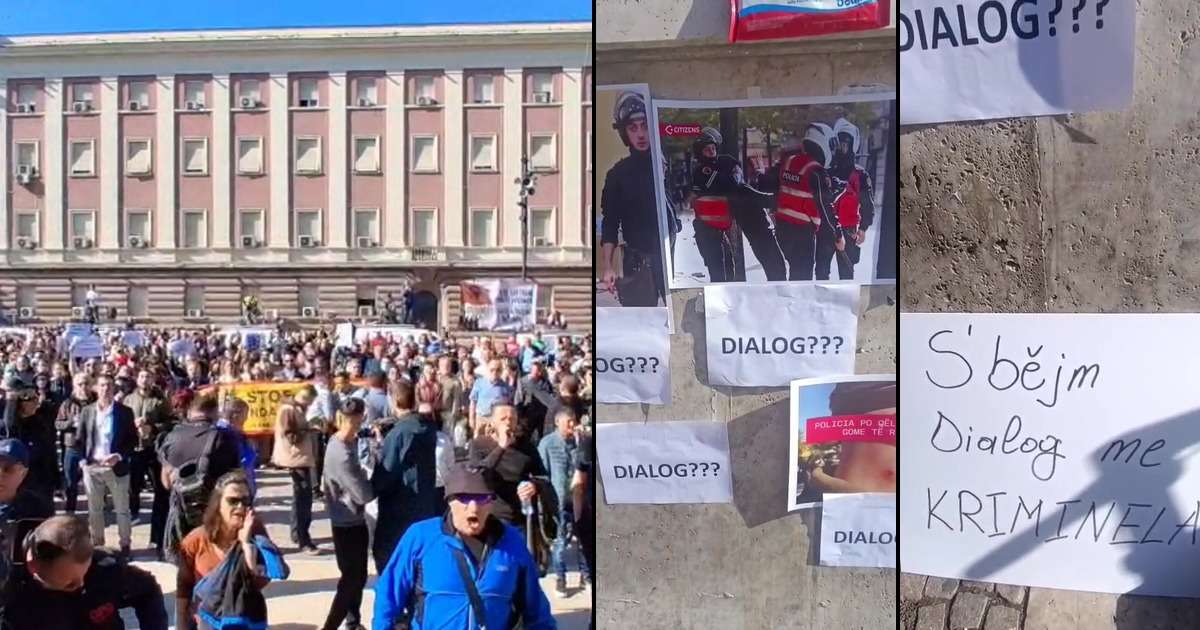
Edi Rama is calling for dialogue today, setting out chairs outside the Kryeministria. But if Rama is truly ready for dialogue, he should be the first to act: instead of setting out chairs, he can bring the change to the electoral law to parliament himself. The party chiefs’ closed lists are written into the Electoral Code—abolishing them takes 84 votes, and Rama’s PS alone holds 83. That way Rama can take the first step and clear the path to change for the students and the people: then the people decide for themselves—not the parties and their chiefs.
Today is the eighth day of the student protests in Tirana. The chairs were pushed aside. The demonstrators, lecturers and students alike, refused to sit down and chanted a non-negotiable demand: “Dorëheqje”—resignation. Over the past seven days there has been tear gas, water cannon and buildings in flames: the crisis has reached a critical point. Parents and university lecturers are now openly standing with the students. On the streets of Tirana, that this government must go is no longer up for debate.
But will a resignation really bring the change the students are demanding if the electoral law is not changed before Rama leaves? A caretaker government brings new elections—but the new government brings only a change of power, not the changes the students want. The existential question for the democratic process is this: Should he be allowed to step down without first being forced to dismantle the electoral system he installed in 2008?
Because this law is not only a breeding ground for corruption; it also blocks the new, progressive forces—it blocks the future. Through these elections, the very two men the students say must go, Rama and Berisha, are the ones who benefit. Neither new leaders nor new parties stand a chance of governing this country and bringing the fresh air—the changes the students want and this country needs.
The Anatomy of Impotence: What Is the 2008 Pact?

To understand why snap elections right now are an institutional trap, one must look back to April 2008. Overriding fierce objections from smaller parties, Edi Rama and Sali Berisha overhauled the constitution to create an electoral framework that strips citizens of their power and elevates party chairmen into absolute oligarchs. The contrast with functioning Western democracies illustrates just how rigged Albania’s system truly is.
The Democratic Standard (The German Model):
In Germany’s personalized proportional system, each voter casts two ballots. The second vote feeds into a national pool, determining each party’s overall seat share. Every vote for a party above the 5 percent threshold carries equal weight nationwide. With the first vote, citizens directly choose an individual representative for their constituency—since the 2023 reform, provided the seat is covered by the party’s second votes. If that lawmaker fails, voters boot them out of office. The politician answers directly to the public.
The Albanian Trap (The 2008 Revision):
In Albania, that direct accountability was severed in 2008. The electoral machinery was turned into a fortress against political competition:
- Regional Isolation Over a National Pool: Albania was carved up into 12 regional districts. As defined in Article 74, Paragraph 1 of the Electoral Code: “The electoral zone corresponds to the territory of the region and serves as the electoral unit for electing a set number of seats.” In small counties like Kukës, only three parliamentary seats are allocated (2025: PS one, PD two). If an insurgent, youth-led party captures an impressive 15 percent of the local vote, it mathematically wins zero seats. Every one of those ballots goes without a single MP. The system psychologically coerces voters into backing either Rama’s PS or Berisha’s PD simply to prevent their votes from being incinerated.
- The Ban on Pre-Election Coalitions (2020): In 2020, Rama’s majority tightened the screws—at a time when the Democratic Party had surrendered its seats and sat outside parliament: the Electoral Code amendment of October 5, 2020 (97 votes in favor) abolished composite coalitions. Since then, smaller parties have been barred from forming traditional joint coalitions that preserve their party identities. They must either disband or be subsumed under the ballot line of a dominant party.
- The Illusion of “Open Lists” (The July 2024 Fix): Conventional wisdom claims recent reforms made Albania more democratic through preferential voting. The fine print tells the exact opposite story. In July 2024, Rama and Berisha quietly updated the rules: Alongside the open list, every party files a closed, rigid “Safe List” (lista e sigurtë) with as many names as one-third of the district’s seats (Electoral Code, Article 67, Paragraph 2), ranked exclusively by the party boss. The trick is enshrined in the Electoral Code, Article 163, Paragraph 3: “Mandates for winning candidates are distributed first according to the ranking of the fixed-order multi-name list…”. The open list only comes into play once a party wins more seats in a district than its safe list has names—which only PS and PD manage. As the daily Shqiptarja noted when the rules were implemented in January 2025, smaller parties get almost no MPs through the open list. With 46 safe-list slots per party nationwide, PS and PD filled up to 92 of their 133 seats in 2025 with names the party chief had placed. For everyone else, the “preferential vote” is a mathematical mirage.

The Electoral Code as a Corruption Pipeline: The Market for Seats
Albania’s post-2008 framework is not merely mathematically skewed; it is the institutional engine driving political corruption. The moment the two leaders took candidate selection away from voters, parliamentary seats were turned into commodified assets.
To secure a spot on the “safe list,” a candidate does not need to win over local constituents—only the party boss. Before the 2025 election, Berisha placed his loyalists on the safe lists after scrapping his party’s primaries, the daily Shqiptarja reported on March 14, 2025. The Institute for Political Studies (ISP) found in its 2025 election factsheet that “none of the parties publish electoral campaign expenditures” and that “parties continue to run active systems of electoral patronage.” Over the past decade and a half, this backroom pipeline brought people with criminal records straight into Albania’s parliament.
The fact that Albania ultimately had to enact a sweeping “Decriminalization Law” just to strip convicted felons of their parliamentary credentials was no freak accident. It was the direct, predictable outcome of closed lists engineered in 2008. Rushing into elections under this code will not deliver representative democracy; it will simply reboot the marketplace for legislative seats.
The “Caretaker Government” Illusion and the Silence of the Professoriat
Those cheering for an immediate resignation to make way for a caretaker government are ignoring fundamental constitutional realities. A caretaker administration has only one legal task: keeping the lights on until election day. It possesses neither the constitutional mandate nor the votes: amending the Electoral Code requires 84 of 140 MPs (three-fifths, Article 81 of the Constitution), and replacing the regional zones with a national pool means amending Article 64 of the Constitution itself—94 votes (two-thirds).
Albanian attorney Selim Kryeziu, a former appeals court judge, confirmed this baseline reality in response to our inquiry. Asked whether, after a Rama resignation and under a caretaker government, elections would again be held under the 2008 system with its 12 districts—since a caretaker government cannot change the Code without 84 votes in parliament—and whether this system mathematically burns the votes of new forces in districts like Kukës, he replied: “That is correct. Elections will be held under the law that is currently in force”. Kryeziu does not speak as an opponent of the protest: on October 16 he wrote publicly that, “as a former student of December ‘90,” he stands “in support of the students” and is ready to represent them “free of charge in court.”
Attorney Arben Braçe, a former university lecturer, confirmed this in response to our inquiry: “If early elections are held without changing the Electoral Code, the regional proportional system with 12 districts applies, under Article 64 of the Constitution and Article 74 of the Electoral Code.” A caretaker government, he explained, cannot change the electoral system on its own: under Article 81, Paragraph 2, Letter “a” of the Constitution, any amendment to the Electoral Code requires 84 of the 140 MPs. In districts with few seats, such as Kukës with three, small parties “can win votes without winning a single MP.” His conclusion: “So without a change in the law, elections are held under the current system of 12 districts—because the change requires 84 votes in parliament, regardless of whether the government is political or technical.”
A snap election held within a few months would run under the exact same disenfranchising rules. The 2025 parliamentary elections demonstrated how this plays out: 24,547 voters (1.53 percent) backed independent reform platforms like Lëvizja Bashkë, yet the regional barriers swallowed their ballots, yielding just a single mandate nationwide. Meanwhile, Rama’s PS (83 seats) and Berisha’s PD (50 seats) divided nearly the entire legislature between themselves. Starker still: Partia Mundësia won 48,952 votes (3.05 percent) but only 2 of 140 seats; the Nisma Shqipëria Bëhet coalition won 64,212 votes (4.00 percent) but just one seat.
This reality makes the current street dynamic profoundly suspicious. While the presence of university professors lends moral legitimacy to the rallies, the order of the movement’s demands plays straight into the trap. Amending the Electoral Code has been part of the movement’s platform since June: activist Arvina Lleshi reads it out as part of the third demand, constitutional changes to be adopted by popular referendum. But it comes after the first two demands: “the non-negotiable resignation of the prime minister and the government” and a transitional, non-partisan technical government “with a 12-month mandate.” Student Emi Meçani put it in the same order on October 15, on Euronews Albania’s “Tonight” program: “We demand the prime minister’s resignation and that the country go to elections with a new Electoral Code.” The movement does want a new code—but after the resignation. Yet, as attorney Braçe points out, amending the code takes 84 votes in parliament “regardless of whether the government is political or technical”—and today Rama’s PS alone holds 83 of them. And the academics—who understand the country’s legal structures better than anyone—are chanting only “Dorëheqje” while ignoring the electoral trap.
This silence speaks volumes. Either Albania’s intellectual elite fails to comprehend the legal machinery—an implausible scenario—or the movement is being co-opted. It is widely understood that university faculties harbor entrenched party networks. Sali Berisha did not continue his party’s own protest series after the rally of May 8, 2026—yet on October 18 he called for a “national mobilization in support of the revolt.” As head of an associate member of the European People’s Party (EPP), Berisha openly courts the Trump camp, positioning himself to capture the momentum. The students and parents are providing the moral fire against Rama, while the old guard prepares to seize power using the exact 2008 architecture the street has failed to challenge.
And the new parties? Since October 2025, PS and PD have sat together on a special parliamentary commission on electoral reform (approved with 113 votes; Agron Shehaj of Partia Mundësia voted against). In May 2026, a PS-PD project for a 4 percent threshold surfaced—at the last elections, most new forces won between 1 and 3 percent. Shehaj himself said at the time: “The truth is that this system aims to wipe out new parties.” Now he stands with the students: on October 13 he demanded that Rama resign “as soon as possible,” and as early as June he called early elections—possibly with a technical government in between—the end point of the crisis. In an interview on Top Channel’s “Breaking” program on October 19, he issued Rama an ultimatum and called his invitation to dialogue “tallje”—a mockery. He also spoke with a student.
Asked why he does not demand the change to the Electoral Code together with the resignation, Shehaj replied on October 20: “I trust you understand that this is the students’ protest and I am there to support them, but I cannot raise it there as an issue.” Shehaj thus supports the students’ protest and their demand for Rama’s resignation, but does not use the protest for his own party—unlike Berisha with his call of October 18. Yet precisely for that reason, the demand falls to the students themselves: if not even the parties the 2008 pact disadvantages—such as Shehaj’s Partia Mundësia—will carry it into the streets, the students must do it: the demand is in their platform—but it must come before the resignation, not after it. For they chant “në burg”—to prison—not only for Rama but for Berisha too, and so they are demanding new leaders, which the current law cannot give them.
The Ultimatum: First the Law, Then the Exit
The righteous anger of Albania’s professors, parents, and students will evaporate into historical irrelevance if it remains fixated on removing one man. Shuffling prime ministers changes nothing about the country’s structural decline.
The chairs outside the Kryeministria should not have been cleared away. Protest leaders should have occupied them—not to plead for concessions, but to deliver a binding ultimatum:
No snap elections, and no peaceful exit for the government, until Parliament repeals the 2008 electoral system.
A single nationwide electoral pool and the complete abolition of the party bosses’ “safe lists” are the non-negotiable prerequisites (Pushteti i barabartë) for returning power to the citizens. Sali Berisha is demanding swift snap elections precisely because he needs the 2008 code to seize power without facing genuine, pluralistic competition.
Edi Rama must step down. But Albania must not let him out the door until he is forced to unlock the cage he helped build. Change the electoral law first; hold elections second. Anything less is a betrayal of the movement shaking Albania’s streets.
Sources
Electoral Code, consolidated through Law 10/2025 (Articles 2, 67, 74, 163)
Law No. 81/2024 of July 26, 2024
Law No. 9904 of April 21, 2008 (constitutional amendment, Article 64)
Law No. 138/2015 of December 17, 2015 (“Decriminalization Law”)
CEC: PS seat allocation, Tirana 2025
ISP: factsheet on parties and the 2025 electoral process
US State Department: designation of Sali Berisha (2021)
Gazeta Tema, June 12, 2026: waiver, listing remains
Top Channel, “Breaking,” Oct. 19, 2026: Agron Shehaj
Top Channel, Oct. 13, 2026: Shehaj demands Rama’s resignation
Balkanweb, May 5, 2026: Shehaj on the 4 percent threshold
Koha Jonë, May 5, 2026: PS-PD 4 percent threshold project
Shqiptarja, Oct. 27, 2025: special electoral reform commission (113 votes)
Shqiptarja, Jan. 22, 2025: 46 closed-list slots
Shqiptarja, March 14, 2025: Berisha and the safe lists
Shqiptarja, Oct. 5, 2020: Electoral Code amendment (97 votes)
Bulevard, Oct. 20, 2026: the chairs outside the Kryeministria
Top Channel, Oct. 18, 2026: Berisha’s call for mobilization
Read more in The Injustice Chronicle
A Warning Europe Cannot Afford to Ignore
Trump’s Europe: How Washington Gains Influence Without Brussels’ Approval


